
ZOE Gut Health Program Review (2026): A Doctor’s Look at the Evidence

📖 Table of Contents

Section 1: Introduction to Zoe gut health program
If you’ve spent any time reading about nutrition over the past couple of years, you’ve probably come across the ZOE Gut Health Program. It has been featured in podcasts, health magazines, social media, and countless online discussions. One of its biggest promises is that there is no single “perfect diet” because each person’s body responds differently to food.
As a physician, I understand why that idea appeals to so many people. Two people can eat the same breakfast, yet one feels satisfied for hours while the other is hungry again before lunchtime. Some people seem to tolerate certain foods without any problems, while others experience bloating, fatigue, or noticeable changes in their blood sugar. Nutrition is clearly more personal than we once believed.
That said, a good scientific idea doesn’t automatically make every commercial program worth the investment.
The ZOE program combines at-home testing, continuous glucose monitoring, and gut microbiome analysis to provide personalized dietary recommendations. It has attracted attention from researchers, healthcare professionals, and consumers alike. It has also raised plenty of questions, especially because the program costs considerably more than most nutrition apps.
Before recommending any health program to patients or readers, I believe it’s important to look beyond the marketing. Does the science support the claims? Who is most likely to benefit? Are there limitations that people should know before spending their money?
To answer those questions, I reviewed the available research behind the program, examined how the testing process works, looked at feedback from real users, and considered where the evidence is strong and where it is still evolving.
In this review, I’ll explain what ZOE offers, what current research tells us, where I think the program performs well, where I think expectations should be more realistic, and whether it’s something I would recommend in everyday clinical practice.
Section 2: What Is the ZOE Gut Health Program?
The ZOE Gut Health Program is a personalized nutrition service designed to help people understand how their bodies respond to different foods. Instead of recommending the same diet for everyone, the program uses information collected from your own body to generate tailored nutrition advice.
The idea behind ZOE is relatively straightforward. Although general healthy eating principles apply to most people, research suggests that individuals can have very different responses to the same meal. Factors such as gut bacteria, blood sugar responses, sleep, physical activity, and genetics all appear to influence how we process food.
The company was co-founded by Professor Tim Spector, a British epidemiologist and researcher best known for his work on nutrition, the gut microbiome, and twin studies. Alongside Jonathan Wolf and George Hadjigeorgiou, the team developed ZOE to translate findings from large nutrition studies into practical dietary guidance that people can use at home.
Unlike many diet plans that focus primarily on calorie counting or restricting certain foods, ZOE aims to help users understand how food affects their own body. The goal is to encourage long-term eating habits based on individual biological responses rather than following a universal meal plan.
Today, the program is available in several countries, including the United States and the United Kingdom, with enrollment completed entirely online.
Section 3: What Do You Receive When You Join?
After enrolling, participants receive an at-home testing kit containing several components that work together to build a personalized nutrition profile.
Continuous Glucose Monitor (CGM)
One of the most recognizable parts of the program is the continuous glucose monitor. This small sensor is usually worn on the back of the upper arm for about two weeks. It measures glucose levels throughout the day, allowing users to see how different meals, physical activity, stress, and sleep may influence blood sugar patterns.
Although CGMs have traditionally been used by people with diabetes, they are increasingly being studied as a tool for understanding metabolic health in people without diabetes. It’s worth noting, however, that experts continue to debate how useful continuous glucose monitoring is for healthy adults over the long term.
Blood Fat Test
The kit also includes a finger-prick blood test that helps assess how efficiently your body clears fats from the bloodstream after eating. This information is combined with other measurements to provide a broader picture of your metabolic response to food.
Because elevated post-meal blood fat levels have been linked to cardiovascular risk, understanding these responses may provide additional insights beyond blood sugar alone.
Gut Microbiome Test
Participants are also asked to collect a stool sample, which is analyzed to examine the composition of bacteria living in the digestive tract.
The gut microbiome has become one of the fastest-growing areas of nutrition research. Scientists have found associations between gut bacteria and several aspects of health, including digestion, immune function, and metabolism. However, this remains an evolving field, and researchers are still working to understand exactly how changes in the microbiome should influence individual dietary recommendations.
Standardized Test Meals
As part of the assessment, ZOE asks participants to eat specially prepared muffins on designated testing days. These meals contain carefully measured amounts of carbohydrates and fat, allowing researchers to compare metabolic responses under standardized conditions.
While eating colorful muffins may seem unusual at first, using standardized meals helps reduce variation during testing and makes the collected data more meaningful.
Personalized Results
After the laboratory receives and analyzes the samples, users gain access to their results through the ZOE mobile app.
Rather than simply labeling foods as “good” or “bad,” the app assigns personalized food scores and offers practical suggestions based on an individual’s test results. It also provides meal recommendations, educational content, and strategies that may help improve dietary choices over time.
One aspect I appreciate is that the program encourages people to think about overall meal quality and food combinations, rather than viewing nutrition as a list of forbidden foods. That approach is generally more realistic and easier to maintain over the long term.
Section 4: What Do Real Users Say About ZOE?
Scientific studies can tell us whether a health program is promising, but customer experiences show us what happens when people actually use it in everyday life.
For a program that costs several hundred dollars, it is reasonable to ask: Are real users satisfied with what they receive?
I reviewed feedback from public platforms, including Trustpilot and app store ratings, to understand both the strengths and complaints from customers.
⭐ Trustpilot Customer Rating
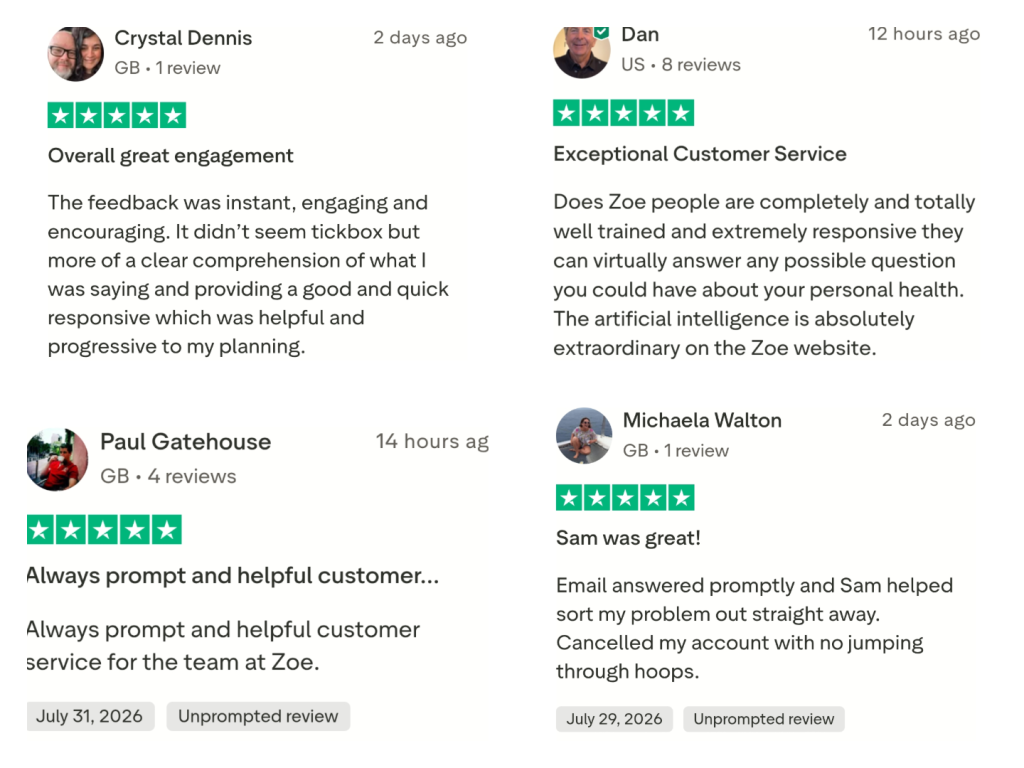
Trustpilot Rating: ⭐⭐⭐⭐☆ 4.1/5 stars
Based on: 13,000+ customer reviews
Many ZOE users report positive experiences with the program. Common themes among satisfied customers include:
✅ Better awareness of how different foods affect their body
✅ Increased focus on fiber-rich foods and plant diversity
✅ A better understanding of their eating patterns
✅ An engaging app experience that helps them stay accountable
Some users appreciate that ZOE does not simply provide a restrictive diet plan. Instead, it encourages people to understand their own responses and make gradual improvements.
⭐ Apple App Store Rating
Apple App Store Rating: ⭐⭐⭐⭐⭐ 4.8/5 stars
Many app users praise:
✅ The clean and easy-to-use design
✅ The educational explanations about nutrition
✅ The food scoring system
✅ The motivation to make healthier choices
Clinical Evidence: Review of the Science Behind ZOE
As a physician, I evaluate clinical evidence rather than marketing claims. The ZOE Gut Health Program is built on research in personalized nutrition, with its recommendations largely supported by peer-reviewed studies. While the early findings are promising, it is important to examine both the strengths and limitations of the available evidence before deciding whether the program is worth the investment.
Metabolic Variability and the PREDICT-1 Trial
The scientific foundation of ZOE comes primarily from the landmark PREDICT-1 study published in Nature Medicine (Berry et al., 2020). This large-scale study followed more than 1,000 participants, including identical twins, to investigate how different people respond to the same meals.
Researchers discovered that blood sugar, insulin, and blood fat responses varied considerably between individuals—even among identical twins who share nearly all of their genetic makeup. These findings suggest that genetics alone cannot predict how a person’s body will process food and support the idea that personalized nutrition may be more effective than a one-size-fits-all dietary approach.
Clinical Interpretation: The PREDICT-1 study provides strong evidence that individual metabolic responses differ significantly, helping explain why a diet that works well for one person may produce different results in another.
Real-World Weight and Lipid Outcomes: The METHOD Trial
To determine whether personalized nutrition could improve health outcomes, researchers conducted the METHOD randomized controlled trial (Bermingham et al., 2024). Over an 18-week period, adults using ZOE’s personalized nutrition program were compared with participants following standard national dietary advice.
The study reported that participants using the personalized nutrition approach experienced greater reductions in triglyceride levels, waist circumference, and improvements in gut microbiome composition compared with the control group. These findings suggest that individualized dietary recommendations may provide additional metabolic benefits beyond conventional healthy eating advice.
However, one important limitation deserves attention. The METHOD trial received funding from ZOE, meaning the results should be interpreted alongside future independent studies. Although industry-funded research can still be scientifically rigorous, independent replication is essential before drawing definitive conclusions about long-term effectiveness.
Clinical Interpretation: Current evidence suggests that personalized nutrition has potential to improve certain cardiometabolic risk factors, but additional independent long-term studies are still needed.
Strength of the Current Evidence
| Clinical Question | Current Evidence |
|---|---|
| Is personalized nutrition supported by research? | ✅ Yes |
| Are the studies peer-reviewed? | ✅ Yes |
| Were randomized controlled trials conducted? | ✅ Yes |
| Are long-term benefits fully established? | ⚠️ Not yet |
| Has independent replication been completed? | ⚠️ Limited |
Clinical Bottom Line
From a physician’s perspective, the science behind ZOE is supported by credible, peer-reviewed research and represents one of the more evidence-based personalized nutrition programs currently available. The strongest evidence demonstrates that people can respond very differently to identical foods and that personalized dietary advice may improve certain cardiometabolic markers.
Pros and Cons of the ZOE Gut Health Program.
it iis important to know the importance advantages and disadvantages of ZOE gut health program.
The Potential Benefits (Pros)
1. Personalized Nutrition Instead of Generic Advice
One of ZOE’s biggest strengths is that it recognizes something nutrition researchers have been studying for years: people do not always respond to the same foods in the same way.
The program uses your own glucose responses, blood fat responses, and gut microbiome information to provide more individualized recommendations.
2. Encourages Better Food Choices
Rather than focusing only on weight loss or calorie restriction, ZOE encourages users to think about food quality, fiber intake, plant diversity, and balanced meals.
For many people, this may help create healthier eating habits that are easier to maintain.
3. Supported by Nutrition Research
The program is based partly on findings from the PREDICT studies, which explored how different people respond to the same foods.
The research has contributed valuable knowledge about personalized nutrition, although more studies are still needed to determine how much these approaches improve long-term health outcomes.
4. Strong User Experience
Many customers enjoy the educational content, app design, and ability to track their progress over time.
For people who enjoy data and detailed feedback, the experience can be motivating.
The Limitations (Cons)
1. The Cost Is High
The biggest barrier for many people is the price.
The testing kit plus ongoing membership can cost significantly more than traditional approaches to improving diet.
For someone who simply needs guidance on eating more vegetables, increasing fiber, and reducing processed foods, a personalized testing program may not be necessary.
2. The Science Is Still Developing
The gut microbiome is an exciting area of research, but scientists are still learning how to translate microbiome measurements into clear dietary recommendations for every individual.
A microbiome test can provide interesting information, but it should not be viewed as a complete picture of your health.
3. Not Everyone Needs This Level of Testing
Many people can achieve major health improvements through proven basics:
- Eating more whole foods
- Increasing dietary fiber
- Exercising regularly
- Sleeping adequately
- Managing stress
A more expensive personalized approach may be most useful for people who want deeper insights or have struggled despite making lifestyle changes.
ZOE Gut Health Program Pricing (2026)
Pricing can change depending on location, promotions, and membership options.
At the time of writing, the estimated cost is:
| Program Component | Approximate Cost |
|---|---|
| Initial testing kit | Around $299 / £299 |
| Digital membership | Approximately $30–$59 per month depending on plan |
Before purchasing, check the official ZOE website for the most current pricing available in your region.
Frequently Asked Questions About ZOE
1. Is ZOE a medical treatment?
No. ZOE is a personalized nutrition program, not a medical treatment or replacement for care from a healthcare professional.
People with medical conditions such as diabetes, inflammatory bowel disease, or unexplained digestive symptoms should discuss their situation with a qualified healthcare provider.
2. Is ZOE worth the money?
It depends on your goals.
For someone who enjoys data, wants personalized nutrition insights, and can comfortably afford the program, ZOE may provide useful information.
For someone mainly looking to eat healthier, the same money may be better spent on nutritious foods, exercise, or professional nutrition advice.
3. Does ZOE help with weight loss?
ZOE is not specifically a weight-loss program.
Some users may lose weight because the recommendations encourage healthier eating patterns, higher fiber intake, and better food choices. However, individual results will vary.
4. Is the ZOE microbiome test accurate?
The test can identify and analyze the bacteria present in a stool sample, but the interpretation of microbiome data is still an evolving area of science.
Knowing which bacteria are present does not always tell us exactly what changes will improve health.
5. Can ZOE replace seeing a doctor or dietitian?
No.
ZOE can provide nutritional insights, but it does not diagnose disease or replace medical advice.
6. Who may benefit most from ZOE?
The program may be most useful for people who:
- Enjoy tracking health data
- Want a deeper understanding of their food responses
- Have struggled to identify which foods work best for them
- Are willing to invest financially in personalized nutrition
Doctor’s Final Thoughts
ZOE represents an interesting step toward more personalized nutrition. The research behind the idea is promising, and many users appear to enjoy the experience.
However, personalized testing is not a magic solution. The foundation of good health remains the same: a balanced diet, regular movement, quality sleep, and sustainable habits.
Reference
Berry SE, Valdes AM, Drew DA, et al. Human postprandial responses to food and potential for personalized nutrition. Nature Medicine. 2020;26(6):964-973. doi:10.1038/s41591-020-0934-0
https://doi.org/10.1038/s41591-020-0934-0
Bermingham KM, Linenberg J, Garcia-Perez I, et al. A personalized nutrition program improves cardiometabolic health parameters: The METHOD randomized controlled trial. Nature Medicine. 2024;30(6):1621-1631. doi:10.1038/s41591-024-02932-w
https://doi.org/10.1038/s41591-024-02932-w
Bermingham KM, et al. (2024). A personalized nutrition program improves cardiometabolic health parameters: The METHOD randomized controlled trial. Nature Medicine.
https://www.nature.com/articles/s41591-024-02932-w
Berry SE, et al. (2020). Human postprandial responses to food and potential for personalized nutrition. Nature Medicine.
https://www.nature.com/articles/s41591-020-0934-0