
What Common Food or Drink Is Secretly Terrible for Your Health?

Introduction
If you had to choose one common drink that is surprisingly easy to underestimate, then it is sugar-sweetened beverages. I will say they are near the top of the list. Regular soda, sweetened iced tea, sugary coffee drinks, energy drinks, sports drinks, fruit-flavored drinks, and other beverages with added sugar can deliver a substantial amount of sugar without making you feel that it is quite a lot.
The problem is not that drinking one soda occasionally will suddenly make you unhealthy. The concern is frequent consumption over months and years. Yap! That is it.
Research increasingly links high intake of sugar-sweetened beverages with obesity, type 2 diabetes, cardiovascular disease and other health problems. So it is particularly important to pay attention to the kind of drinks you take in, because beverages are often treated as something separate from the diet. Little by little, that habit can start working against your health. Someone may carefully watch what they eat while overlooking the sugar they drink every day. If it is true about you, then lift up your hands.
Why sugary drinks are different from sugary foods
Your body does not respond to every source of sugar in exactly the same dietary context.
When sugar is consumed as part of a whole food, that food may also contain fiber, protein, fat and water. These components can slow eating and contribute to fullness. A sugary drink, by contrast, can be consumed quickly and may provide a large amount of carbohydrate without much protein, fiber or other nutrients.
And this makes beverages particularly easy to underestimate.
Think about someone who drinks a regular soda with lunch every day. The drink may not feel like a substantial part of the meal because it is liquid. You finish it, put the bottle down and continue with your day.
But those calories and sugars still count.
When that happens once in a while, it is very different from making it an everyday habit. The bigger concern is the repeated exposure and what it contributes to your overall energy intake.
What counts as a sugar-sweetened beverage?
Sugar-sweetened beverages are drinks that contain added sugars or other caloric sweeteners.
Common examples include:
- Regular soda and cola
- Sweetened iced tea
- Sweetened coffee drinks
- Energy drinks containing added sugar
- Sports drinks containing added sugar
- Sweetened fruit drinks
- Lemonade and similar sweetened beverages
- Some flavored or sweetened milk drinks
- Sweetened bottled drinks and punches
Now, there is an important distinction here.
Naturally occurring sugar is not the same thing as added sugar.
A whole orange contains naturally occurring sugar, but it also comes with fiber, water and other nutrients. You also have to chew it, which changes how quickly you consume it.
A sweetened drink is different. You can drink a considerable amount of sugar in a few minutes without feeling that you have eaten much at all.
Even 100% fruit juice deserves some caution. It can contain naturally occurring sugars rather than added sugar, but removing much of the fruit’s physical structure makes it much easier to consume the sugars from several pieces of fruit quickly.
So yes, fruit juice is not the same as cola. But that does not mean unlimited juice is automatically a healthy choice.
The connection with weight gain
One of the simplest ways frequent sugary drinks can affect health is through excess energy intake.
What does this mean?
Liquid calories can be surprisingly easy to overlook. A person may drink a sweetened beverage and still eat a normal meal afterward because the drink does not provide the same degree of fullness as solid food.
Over time, regularly consuming more energy than your body needs can contribute to weight gain.
And weight gain itself is not the only concern.
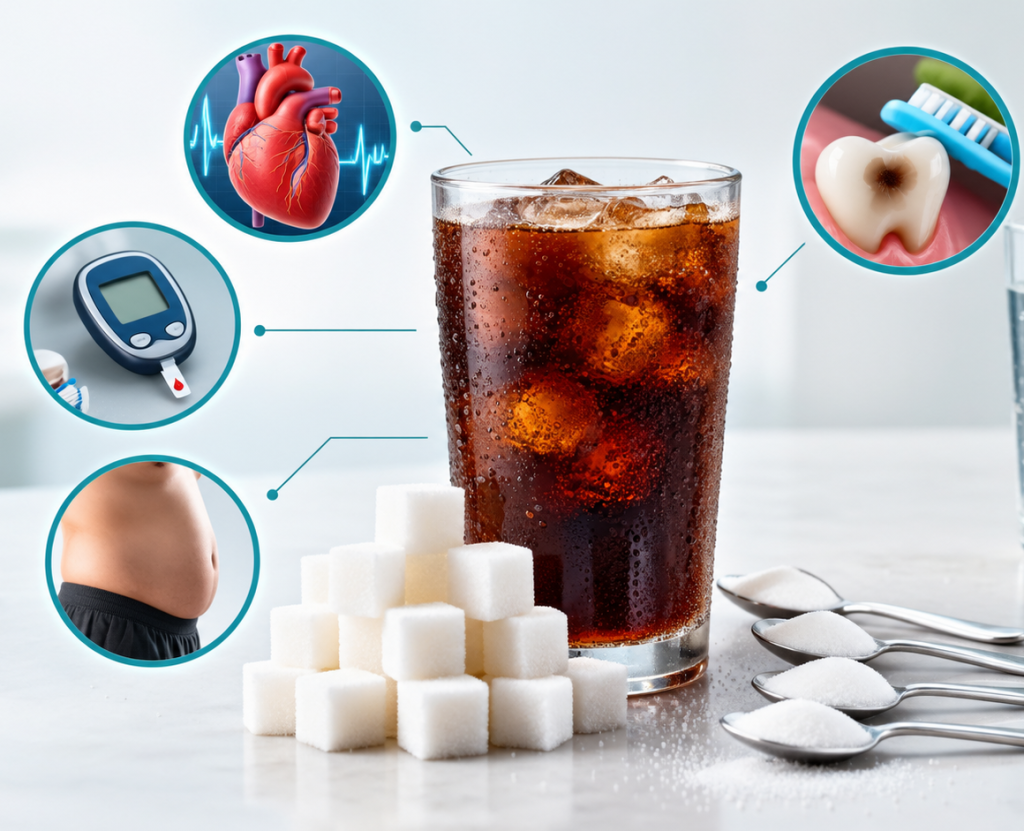
Excess body fat, particularly when it accumulates around internal organs, is associated with metabolic problems including insulin resistance, high blood pressure and abnormal blood lipid levels. Can you now see where this is heading?
A 2025 umbrella review of systematic reviews and meta-analyses found that diets high in sugar-sweetened beverages were associated with increased risk of overweight and obesity. This does not mean that one sugary drink automatically makes someone obese. The issue is the overall pattern of repeated consumption and its contribution to excess energy intake.
That distinction matters.
A birthday party drink is not the same thing as drinking two large sugary beverages every day.
What about type 2 diabetes?
This is one of the more important concerns.
When you drink a sugary beverage, the sugar is absorbed relatively quickly. Your body responds by releasing insulin, the hormone that helps move glucose from the blood into cells.
If someone regularly consumes large amounts of sugary drinks as part of an overall unhealthy diet, the repeated excess energy intake and weight gain can contribute to insulin resistance. Over time, this can increase the risk of developing type 2 diabetes.
And the evidence is not coming from one small study.
A large 2024 umbrella review examined 47 meta-analyses involving more than 22 million people. Overall, 79% of the analyses showed direct associations between greater sugar-sweetened beverage consumption and higher risks of adverse health outcomes. The evidence included convincing associations with type 2 diabetes and cardiovascular disease.
Now, before somebody says, “So you are telling me soda causes diabetes?”
Not exactly.
Much of this evidence comes from observational studies and meta-analyses of observational research, so it is more accurate to say that higher consumption is associated with higher risk. Researchers have to account for other factors that can influence health.
Still, the consistency of the evidence is difficult to ignore.
Your heart may also be affected
People often think about sugary drinks in terms of weight and diabetes. The heart deserves attention too.
Frequent sugar-sweetened beverage consumption has been associated with cardiovascular disease and cardiovascular risk factors. Excess energy intake, weight gain, metabolic changes and disturbances in blood sugar and blood lipid levels can all matter for cardiovascular health.
A 2025 study published in Nature Medicine estimated the global burden of type 2 diabetes and cardiovascular disease attributable to sugar-sweetened beverage consumption across 184 countries.
The estimates were striking. In 2020, the researchers estimated that sugar-sweetened beverages were attributable to about 2.2 million new cases of type 2 diabetes and 1.2 million new cases of cardiovascular disease worldwide.
Sub-Saharan Africa also deserves particular attention. The study estimated that SSB-attributable burdens had increased in the region between 1990 and 2020.
That does not mean every person who drinks soda will develop heart disease.
It means the population-level pattern is important, particularly when these drinks become an everyday part of the diet.
Your teeth may not be happy either
There is another problem that gets less attention than it deserves: your teeth.
Free sugars in foods and drinks are a major risk factor for dental caries, commonly known as tooth decay. When you regularly consume sugary drinks, bacteria in dental plaque can use those sugars and produce acids that damage tooth enamel.
And here is the interesting part: it is not only the amount of sugar that matters. How often you expose your teeth to sugary foods and drinks also matters.
Sipping a sweetened drink repeatedly throughout the day keeps exposing the teeth to an environment that favors tooth decay.
The World Health Organization identifies free sugars as a major dietary risk factor for dental caries and recommends keeping free sugars below 10% of total daily energy intake, with additional benefit from reducing them below 5%. So that innocent-looking bottle you keep sipping at your desk all afternoon? Your teeth know about it.
How much added sugar is too much?
There is no single magic amount that suddenly turns sugar from safe into dangerous.
What matters is your overall dietary pattern and how much added or free sugar you regularly consume.
The American Heart Association recommends limiting added sugars to no more than 6% of daily calories. As a general guide, that is about 25 grams, or 6 teaspoons, per day for women and 36 grams, or 9 teaspoons, for men.
Now look at how easy it can be to reach that amount.
The American Heart Association notes that one 12-ounce can of regular soda can contain around 10 teaspoons of sugar.
That is already more than the recommended daily limit for added sugar for many women, and it uses up a large portion of the daily allowance for men.
And we are talking about one drink.
This is why sugary drinks can quietly become a problem. You may still have breakfast, lunch, dinner, snacks and dessert after that.
What about diet soda or zero-sugar drinks?
This part needs a little more nuance.
A drink labeled “zero sugar” or “diet” does not contain the same amount of sugar as a regular sugary beverage. Replacing a high-sugar drink with a lower- or zero-sugar option can reduce sugar and calorie intake.
However, it would be too simplistic to say that every artificially sweetened beverage is automatically healthy.
Research on artificial sweeteners is complicated. Some studies have reported associations between higher consumption and certain cardiometabolic outcomes, but observational studies can be affected by confounding and reverse causation. For example, people who already have obesity, diabetes or other health concerns may be more likely to choose artificially sweetened drinks.
So I would not turn this into another “good drink versus bad drink” argument. For everyday hydration, water is still the simplest choice. Unsweetened tea and coffee can also fit into a healthy diet for most adults.
Are foods containing sugar automatically unhealthy?
No.
This is where health discussions sometimes go off the rails. Sugar is not a poison, and eating something sweet once in a while does not mean you have damaged your health.
Whole fruits naturally contain sugar, but they also provide fiber, vitamins, minerals and other beneficial compounds. Milk contains naturally occurring lactose along with protein and other nutrients.
The bigger concern is added and free sugars in foods and drinks that provide relatively little nutritional value, particularly when they are consumed frequently and in large amounts.
So you do not need to become frightened every time you see the word “sugar” on a nutrition label. Look at the whole food. Look at the portion. And, most importantly, look at the pattern of what you consume every day.
A simple way to reduce sugary drinks
You do not necessarily have to stop everything overnight.
For many people, starting with the drinks is one of the easiest changes because beverages can add a lot of sugar without providing much fullness.
Try making water your default drink. Choose unsweetened tea or coffee more often. Reduce the amount of sugar you add to drinks gradually if completely unsweetened beverages taste strange at first. And pay attention to serving sizes. A large bottle may contain two or more servings even though it looks like one drink.
Read the label.
That little “added sugars” number can tell you something your eyes cannot.
If you currently drink sugary beverages several times a day, reducing the frequency is already a meaningful step. You do not need to become perfect. You need to become more aware.
The bottom line
So, what common food or drink is secretly terrible for your health?
There is no single food that deserves to be called universally “terrible.” But sugar-sweetened beverages are one of the easiest everyday products to underestimate, especially when consumed frequently.
The concern is not the occasional soda at a celebration. It is the habit of drinking large amounts of added sugar day after day without really counting it as part of your diet.
Research has linked higher consumption with obesity, type 2 diabetes and cardiovascular disease, while WHO also highlights the importance of limiting free sugars to reduce tooth decay.
So next time you reach for that drink, take one second and look at the label. How much sugar are you actually drinking? That little question may be more useful than you think.
References
American Heart Association. (2024). Added sugars. https://www.heart.org/en/healthy-living/healthy-eating/eat-smart/sugar/added-sugars
Lara-Castor, L., O’Hearn, M., Cudhea, F., Miller, V., Shi, P., Zhang, J., Sharib, J. R., Cash, S. B., Barquera, S., Micha, R., & Mozaffarian, D. (2025). Burdens of type 2 diabetes and cardiovascular disease attributable to sugar-sweetened beverages in 184 countries. Nature Medicine, 31(2), 552–564. https://doi.org/10.1038/s41591-024-03345-4
Lane, M. M., Travica, N., Gamage, E., Marshall, S., Trakman, G. L., Young, C., Teasdale, S. B., Dissanayaka, T., Dawson, S. L., Orr, R., Jacka, F. N., O’Neil, A., Lawrence, M., Baker, P., Rebholz, C. M., Du, S., & Marx, W. (2024). Sugar-sweetened beverages and adverse human health outcomes: An umbrella review of meta-analyses of observational studies. Annual Review of Nutrition, 44(1), 383–404. https://doi.org/10.1146/annurev-nutr-062322-020650
Li, B., et al. (2023). Consumption of sugar sweetened beverages, artificially sweetened beverages and fruit juices and risk of type 2 diabetes, hypertension, cardiovascular disease, and mortality: A meta-analysis. Frontiers in Nutrition, 10, 1014716.
World Health Organization. (2015). Guideline: Sugars intake for adults and children. World Health Organization. https://www.who.int/publications/i/item/9789241549028
World Health Organization. (2025, August 14). Sugars and dental caries. https://www.who.int/news-room/fact-sheets/detail/sugars-and-dental-caries